The United Kingdom is preparing a new sanctions regime that would ban trade with Israeli settlements in the occupied West Bank, part of a tougher approach toward Israel following its decision to advance the E1 settlement project that would sever the territory in two. The move comes as more than 100 former British and French diplomats issued a joint letter denouncing Israel's ethnic cleansing and demanding urgent action to halt what they called the erasure of Palestine.
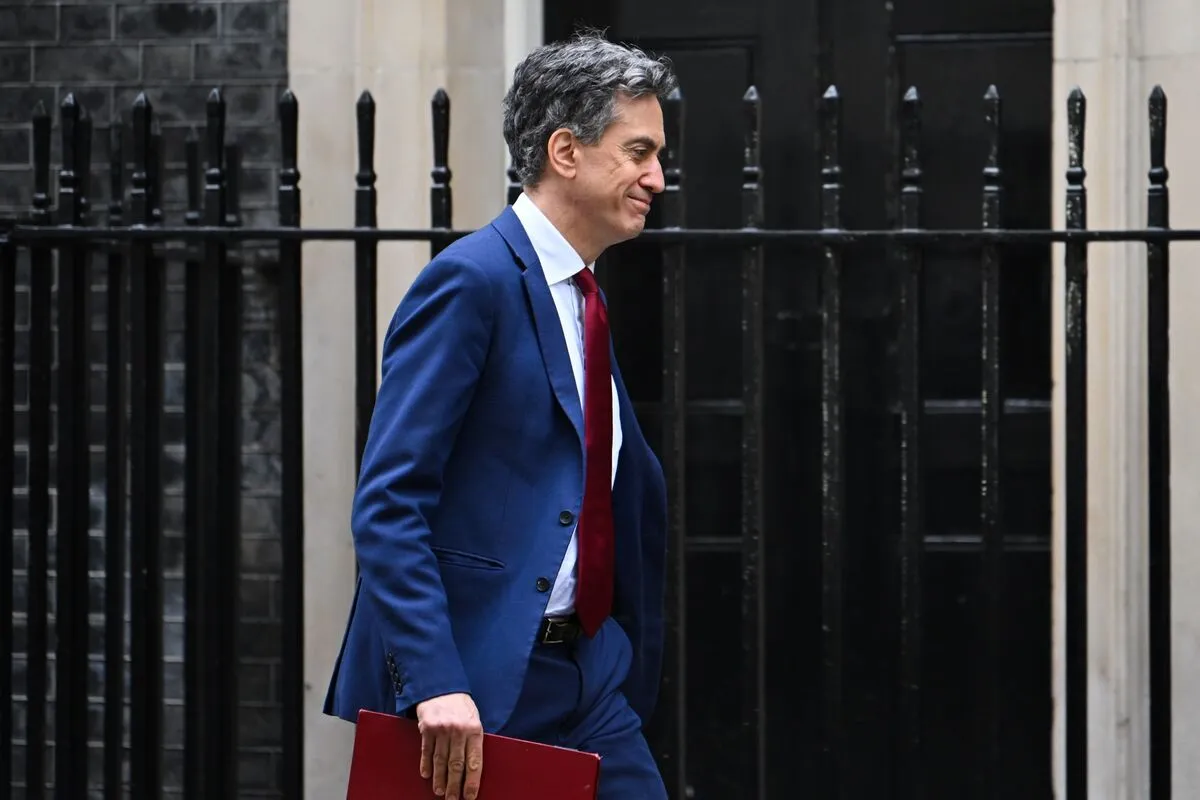
British Foreign Secretary Ed Miliband said this week that Britain would not stand back and accept the destruction of the two-state solution, and that the government was preparing a comprehensive set of measures in response to Israeli policies. According to reporting, officials have drawn up plans for a two-pronged approach: a new sanctions regime to prevent the exchange of goods and services with the settlements, and sanctions targeting individuals involved in the settlement enterprise. Miliband is also weighing an expansion of existing human rights sanctions to cover the obstruction of aid into Gaza, and may explicitly endorse the International Court of Justice's 2024 opinion that Israel's occupation of Palestinian territory is unlawful.
The measures are being drafted in response to Israel's decision to open tenders for the construction of over 1,200 settler homes in the E1 area east of Jerusalem, a plan would cut the occupied West Bank in two, isolate occupied Jerusalem, and end any prospect of a Palestinian state. Miliband called the tender an unacceptable and destructive act and a flagrant breach of international law, and summoned Israel's most senior diplomat in London, the charge d'affaires Daniela Grudsky Ekstein, to demand its reversal.
Israel reacted with defiance. Foreign Minister Gideon Saar dismissed Miliband's remarks as patronizing, likening Israeli settlers on occupied Palestinian land to Britons living in the UK and claiming Jews had the right to live throughout the land. The response laid bare the widening rift as Israel presses ahead with settlement expansion in open disregard of European objections.
The pressure on London intensified sharply with the publication of an unprecedented letter signed by more than 100 former British and French diplomats, including two former British envoys to the UN and a former Foreign Office director for the Middle East, addressed to Prime Minister Andy Burnham and French President Emmanuel Macron. Dispensing with diplomatic language, the signatories denounced Israel's ethnic cleansing and declared that the world no longer sees Israel as a genuine democracy.
The diplomats wrote that nothing justified Israel's systematic policy of destroying Gaza and its population, noting that two million Palestinians had been kettled into 30 percent of their devastated land, deprived of food, medicine, and housing, and that more than 1,200 Palestinians had been killed since what they called the so-called ceasefire. In occupied Jerusalem and the rest of the occupied West Bank, they wrote, Palestinian home demolitions and rampant settler violence, carried out with the connivance of the Israeli army and police, amount to ethnic cleansing, and Palestine is being erased before the world's eyes. They added that the same policy of occupation and destruction extended to Lebanon, where many villages had been razed, and to Syria.
The signatories urged Britain and France to take concrete steps, including upholding the rulings of the International Court of Justice and the International Criminal Court, suspending the EU-Israel and UK-Israel trade agreements over human rights breaches, halting all arms transfers and military cooperation with Israel, banning all trade with the settlements, and making it an offense for British and French citizens to buy property on stolen Palestinian land. They also called for unrestricted aid access to Gaza led by UNRWA and the UN.
British officials acknowledge that the practical impact of a trade ban may be limited, since traders can relabel goods to evade it, but the measures reflect mounting political pressure inside Britain over Israel's conduct. Emily Thornberry, the Labour chair of the Commons foreign affairs committee, said the UK should press ahead with a ban on goods from the occupied West Bank, noting that Britain had taken similar action against Russian businesses operating from occupied Crimea. She said Israel's far-right government was doing its best to extinguish the hope of a Palestinian state by building as many settlements as possible, and that goods from businesses benefiting from an illegal occupation should not be sold in Britain.