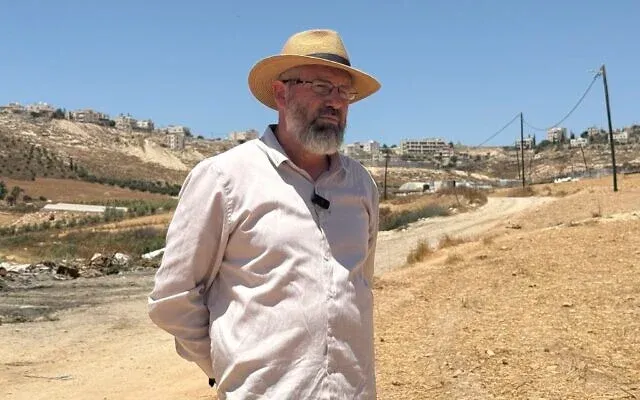
An Israeli settler who runs an environmental organization in the occupied West Bank has published a 112-page report declaring the mountain aquifer, which lies beneath Palestinian land, to be one of "Israel's most strategic water reservoirs," and calling for Israel to take unilateral control of wastewater management across the territory in a sweeping expansion of its grip over Palestinian natural resources.
The report, titled "Murky Waters" and published by Barak Verker of Green Now, describes itself as an environmental study. What it actually is, stripped of the neutral language, is a demand that the Israeli state claim sovereignty over the water and soil of land it has illegally occupied for nearly six decades, framed as environmental concern.
Verker complains that Palestinian wastewater contaminates the aquifer, blaming it on a Palestinian Authority he calls "too weak, inefficient, and corrupt" to build the necessary infrastructure, and noting that the PA has received generous international aid. What he does not note, but every Palestinian knows, is why Palestinian infrastructure is underdeveloped in the first place. Israel controls all construction in Area C, which covers 61 percent of the occupied West Bank. It routinely demolishes Palestinian infrastructure. It restricts the import of construction materials. It blocks the vast majority of Palestinian applications to build.
Most fundamentally, Israel controls all water in the occupied West Bank through a joint committee in which it holds an effective veto. Palestinian communities cannot dig new water wells without Israeli permission, and permission is overwhelmingly denied to Palestinians while being granted to illegal settlements. The reason Palestinian wastewater infrastructure is inadequate is not corruption, but the deliberate, systematic policy of an occupying power.
That occupying power is not a neutral party managing a shared resource. It is the party that constructed more than 700,000 settlers across the occupied West Bank, whose settlements consume over three times more water per capita than Palestinian communities next door. According to World Bank and UN data, Israeli settlers in the occupied West Bank have access to between 300 and 400 liters of water per person per day, while Palestinians are restricted to around 70 to 80 liters, well below the 100-liter minimum recommended by the World Health Organization. The disparity is not natural. It is engineered, enforced by the same water management structures whose failures Verker now attributes to Palestinian governance.
Even Gidon Bromberg of EcoPeace, an Israeli environmental organization that favors cross-border cooperation, told the Times of Israel that handing water management to Israel unilaterally "would mean that Israel takes full control of all Palestinian cities and towns," noting that it would breach existing agreements requiring each side to treat its own sewage.
And Gaza? The same logic of water as an Israeli resource has been enacted there with devastating finality. Since October 2023, Israel has systematically bombed and destroyed Gaza's water and sanitation infrastructure, targeting desalination plants, water pumping stations, and wastewater treatment facilities as part of its genocide. It cut the main water pipeline supplying northern Gaza in the early days of the genocide. Its forces have bombed water tankers and the queues of Palestinians waiting to receive water, killing civilians whose only "crime" was waiting for a cup to drink. According to the UN, Gaza's water system has been almost entirely destroyed, leaving barely any clean water for two million people who are simultaneously denied the materials needed to rebuild it by the same siege that destroyed it. An occupation that has engineered a water catastrophe in Gaza now, through one of its settler organizations, demands to protect the water of the occupied West Bank from Palestinian wastewater.