
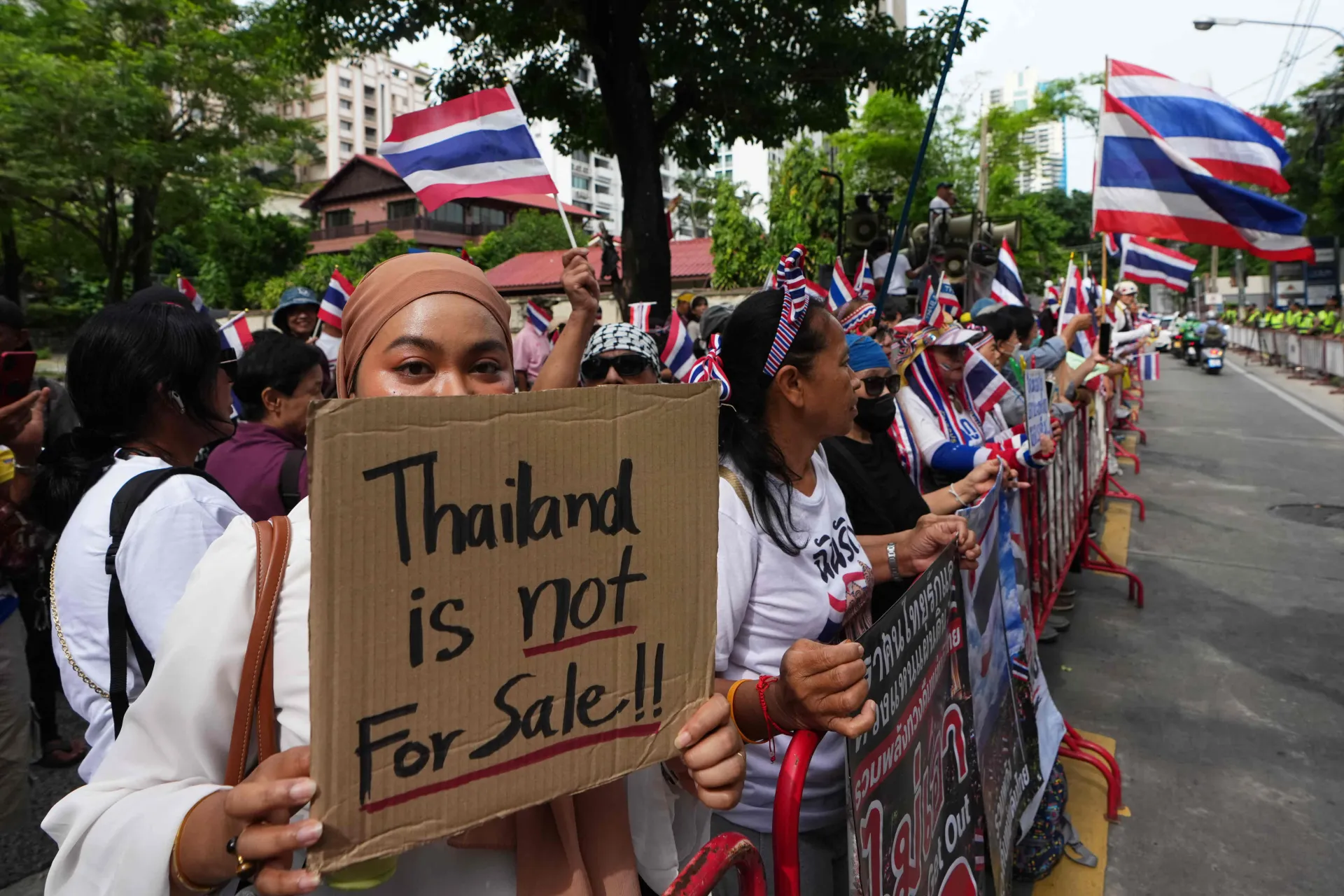
Hundreds of people demonstrated outside Israel's embassy in Bangkok on Thursday, demanding that foreign visitors show greater respect for Thailand's laws and culture, in a protest fueled by growing public anger that has increasingly centered on Israeli tourists, their seizure of Thai land, and Israel's ongoing genocide in Gaza.
Protesters gathered outside the embassy holding signs demanding an end to what they described as land-grabbing by foreigners, under the rallying cry that "Thailand is not for sale." The demonstration was led by the veteran Thai media figure and political activist Sondhi Limthongkul, who read aloud an open letter addressed to Israel's ambassador to Thailand, Alona Fisher-Kamm. "The era of gentle diplomatic pleasantries and calculated silence, which has been misinterpreted as tacit consent, has come to an end," he told the crowd.
The protesters' grievances centered on three connected issues: the conduct of Israeli tourists, foreign acquisition of Thai land and businesses, and Israel's war on Gaza. Discontent has been building in Thailand over the behavior of some foreign visitors, with one of the highest-profile recent cases involving an Israeli tourist convicted over a confrontation in the country. Much of the anger has focused on the northern town of Pai, a once-quiet destination that has seen a large influx of Israeli visitors and Israeli-run businesses, prompting local complaints about foreigners buying up land and property and operating enterprises in ways residents say sideline Thai law and Thai communities.
The concerns have registered at the highest levels of the Thai government. Thailand's Foreign Minister Sihasak Phuangketkeow met the Israeli ambassador earlier in the week to address the issue, and said afterward that Thailand could not stand idly by if visitors behaved detrimentally toward the country or its people. "Thailand is a country that welcomes tourists, but at the same time, our hospitality doesn't mean that tourists, regardless of their nationality, can do whatever they want in Thailand," he told reporters in Bangkok.
The Israeli embassy moved to contain the backlash. Its deputy chief of mission, Rami Teplitskiy, said in a video message that the embassy was not ignoring the negative sentiment about Israeli tourists and would work to ensure visitors respected Thai laws and culture, while the ambassador proposed issuing a "do's and don'ts" guide for Israeli travelers, one of the demands raised by the protesters.
The protest reflects a broader phenomenon that has accompanied Israel's genocide in Gaza: a growing global revulsion toward the conduct of Israelis abroad, from soldiers pursued for war crimes to tourists accused of behaving as though local laws do not apply to them. In Thailand, that sentiment has fused with longstanding local anxieties about foreign land acquisition and the transformation of Thai towns, producing a rare public demonstration outside an Israeli mission in a country that has generally maintained warm ties with Israel.